Genome
So I recently got my genome sequenced. I mostly did it for intellectual reasons, since a decent chunk of my job is being at the leading edge of current scientific understanding of interpreting what a given protein coding change may mean, disease-wise, when encountered in a human genome. While that did lead me to ignore the huge number of changes that exist in the non protein-coding parts of the genome, I’m inevitably looking for anything interesting I encounter within protein coding sequence (ie. including nonsense mutations and frameshifts).
Here’s a list of some of the things I’ve found so far.
rs201653371 in SLC10A1. Has a very low allele frequency of 6.83E-06, and seemingly only found in east-asians, so presumably comes from my japanese side. This C>T nucleotide change makes a tryptophan to stop-codon change at residue 305. The protein itself is 349 residues long, so it truncates the protein roughly 90% of the way. Interestingly, it’s not clear whether this nonsense variant would be a true null allele; the truncation happens 5 amino acids from the end of the last transmembrane domain, so it’s unclear whether the channel would fully fold or not (ie. I can’t tell if it would take a minor or major hit on cell surface localization). It would be missing its entire intrinsically disordered cytoplasmic tail, which likely contains key regulatory motifs. Indeed, a quick AI search suggests some Tyrosine-based sorting motifs for clathrin mediated endocyosis and some phosphorylation sites. The image below shows the rare variant copy I encode in rainbow, and the part missing in gray.
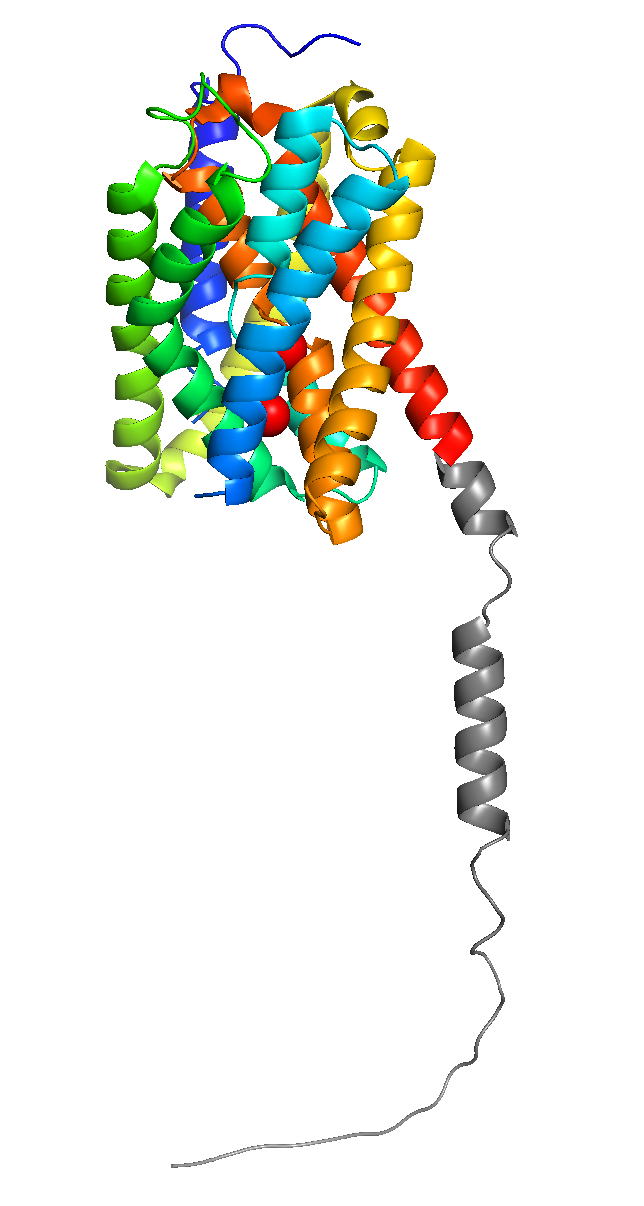
I’ll note that I’m obviously heterozygous for this variant, so half of the copies of this protein being made by my body would be the full thing, while the other half is the shortened version. Even if the shortened version is deficient in function, it’s highly likely that the full-length protein is pulling any needed weight to compensate. Why can I say that? Well, for starters, I don’t have any symptoms associated with the disease that seems to occur when there are two poorly functional copies, which causes familial Hypercholanemia type 2. This is linked to the proteins function.
This protein is on the plasma membrane of hepatocytes (liver cells), and helps to re-uptake the bile acids that were secreted into the intestines earlier for emulsifying the fats from a meal (in other words, making them little soluble droplets so they can be more easily handled in a watery environment). It cleans the bile out of the portal blood, which is essentially the blood draining from your intestines that pass by the liver before going back out to the rest of your body. If SLC10A1 isn’t doing its job, then those bile acids used for digestion make it out into the bloodstream and cause jaundice. Apparently it’s a relatively mild disease though, with no major health consequences, since you have backup systems (kidneys to excrete some of the bile acids into urine, also OATP1B1 and OATP1B3 to still extract enough bile acids to keep your digestive system going).
Also, fascinatingly, this protein is also the receptor for hepatitis B virus (and also Hepatitis D). There are actually a decent number of other variants in SLC10A1 that are at high frequency in east asians, such as S267F, and it’s thought that this mutation makes the individual more resistant to hepatitis B infection (which is prevalent there).
Summary: I have a truncated variant of SLC10A1. Even having two bad copies isn’t a huge life-altering thing, so there’s very little worry about this one.